
Does Your Business Need CCPA Consulting?
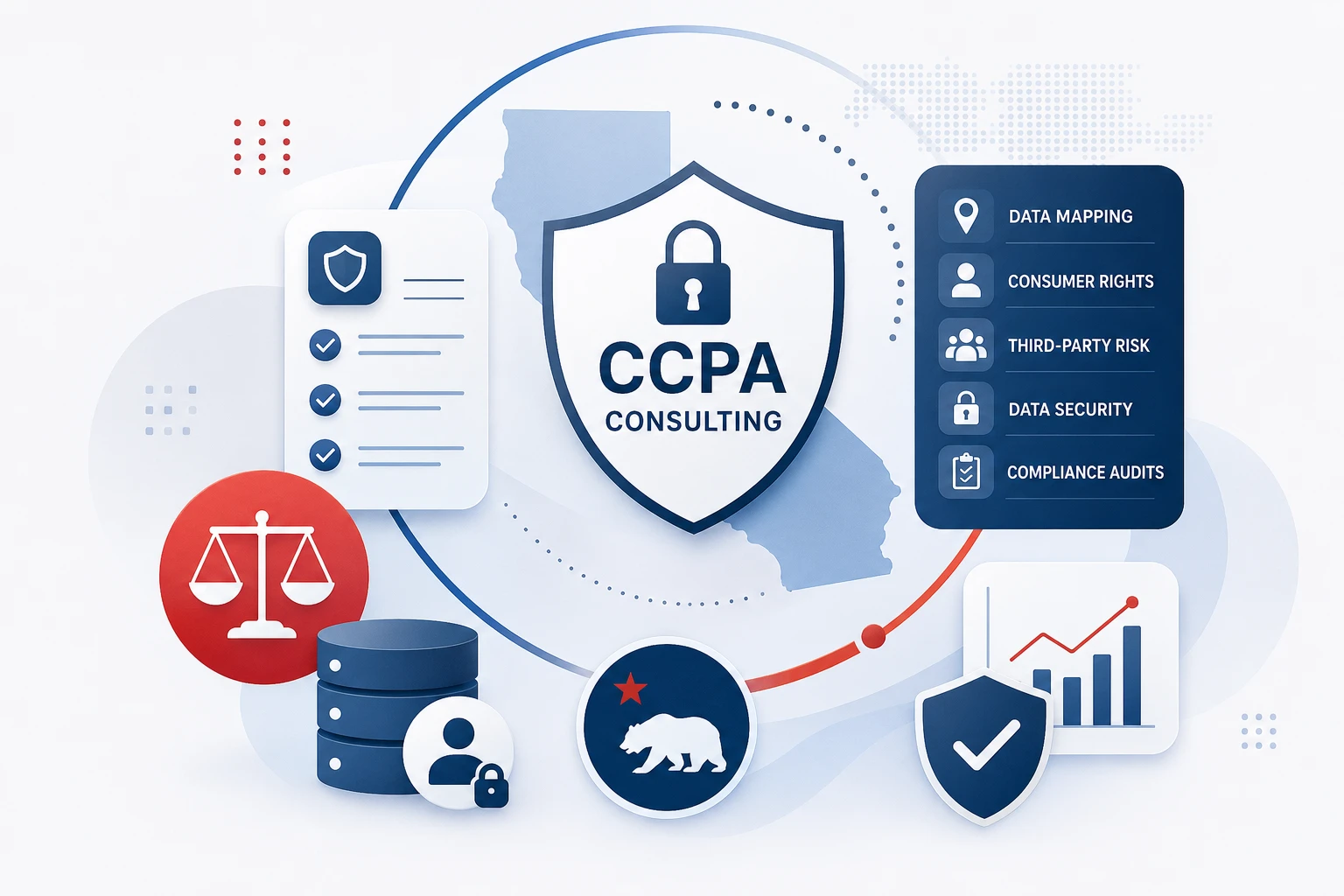
CCPA consulting is a professional advisory service that helps a business determine whether the California Consumer Privacy Act applies, understand how personal information moves through its operations, identify compliance gaps, and implement practical privacy controls. The work may include applicability analysis, data mapping, privacy notices, consumer request procedures, opt-out mechanisms, vendor governance, risk assessments, and preparation for applicable cybersecurity audit requirements.
Does your business need CCPA consulting?
This guide explains how to evaluate CCPA applicability, recognize operational gaps that may require outside support, and decide whether your internal legal, privacy, security, and technology teams can manage the work effectively.
CCPA compliance affects more than a privacy policy. A covered business may need coordinated processes for data inventories, consumer requests, opt-out signals, vendor contracts, security controls, and regulatory documentation. Consulting support can help business leaders turn those requirements into responsibilities that teams can consistently carry out.
The California Consumer Privacy Act can be difficult to interpret from an operational perspective. The law involves legal requirements, but compliance also depends on how a business collects information, configures technology, manages vendors, responds to consumers, and documents internal decisions.
A legal team may interpret the law while privacy, information security, marketing, human resources, procurement, and IT teams handle different parts of implementation. Problems often arise when those responsibilities are not coordinated or when written notices do not match what systems and employees actually do.
Not every organization needs the same level of outside support. Some businesses have mature privacy teams and established governance processes. Others need help determining whether the law applies, identifying information flows, assigning ownership, or building an implementation roadmap.
The central question is therefore not simply whether CCPA consulting exists. It is whether your organization has enough legal, technical, operational, and governance capability to manage its obligations accurately and consistently.
What Is CCPA Consulting?
CCPA consulting helps a business translate California privacy requirements into workable policies, procedures, controls, and assigned responsibilities.
A consultant should not merely provide a generic checklist or template privacy policy. Effective consulting examines the organization’s actual practices, including the information it collects, why that information is used, where it is stored, who receives it, and how consumer requests are handled.
Depending on the business, a consulting engagement may address the following areas:
- Determining whether the organization meets the legal definition of a covered business.
- Identifying categories of personal and sensitive personal information.
- Mapping information across websites, applications, internal systems, vendors, and advertising platforms.
- Comparing public privacy notices with actual processing practices.
- Designing procedures for access, deletion, correction, and other consumer requests.
- Reviewing sale, sharing, targeted advertising, and opt-out practices.
- Evaluating service-provider, contractor, and third-party agreements.
- Clarifying responsibility across legal, privacy, security, marketing, procurement, and IT teams.
- Assessing whether risk-assessment or cybersecurity-audit requirements apply.
- Building an implementation plan with owners, priorities, evidence, and review dates.
The result should be an operating privacy program rather than a collection of disconnected documents.
How to Determine Whether the CCPA Applies
The CCPA generally applies to a for-profit entity that does business in California, collects or has personal information collected on its behalf, determines the purposes and means of processing, and satisfies at least one applicable statutory threshold.
For 2026 planning, the principal thresholds include:
- Annual gross revenue of at least $26.625 million in the preceding calendar year.
- Buying, selling, or sharing the personal information of 100,000 or more California consumers or households in a calendar year.
- Deriving 50 percent or more of annual revenue from selling or sharing consumers’ personal information.
Applicability can also extend through relationships between controlled entities and businesses that share common branding. The analysis should therefore consider the wider corporate structure rather than examining one website or legal entity in isolation.
Thresholds are only the beginning of the review. Terms such as personal information, consumer, sale, sharing, service provider, contractor, and third party have specific meanings under California law. An organization can misunderstand its position when it relies only on ordinary business definitions.
The California Privacy Protection Agency periodically adjusts monetary amounts. Businesses should confirm the current threshold through the Agency’s official monetary-threshold information rather than relying on an older article or cached summary.
Can the CCPA Apply to a Business Outside California?
A business does not need to maintain an office in California for the CCPA to become relevant. An organization located elsewhere may fall within scope when it does business in California, handles California consumers’ personal information, and meets the law’s other criteria.
However, selling a product to one California customer does not automatically establish that every CCPA requirement applies. The business model, processing volume, revenue, corporate relationships, and use of personal information must be evaluated together.
This issue is particularly important for e-commerce companies, software providers, digital platforms, advertising businesses, and international organizations that serve customers throughout the United States without organizing privacy obligations by state.
A consultant can support the applicability review, but questions requiring a legal opinion should be addressed by qualified privacy counsel.
Which Businesses Commonly Need CCPA Consulting?
Industry alone does not determine whether the CCPA applies. Certain business models, however, tend to create more complicated information flows and make outside implementation support more valuable.
Organizations that commonly face this complexity include:
- Retail and e-commerce businesses using customer accounts, loyalty programs, analytics, and advertising platforms.
- SaaS and technology companies processing account, device, usage, support, and product-analytics data.
- Marketing and advertising businesses involved in audience measurement, profiling, cross-context behavioral advertising, or data sharing.
- Financial technology companies combining identity, transaction, device, and risk information across multiple systems.
- Healthcare-related companies handling information that may include both regulated medical data and personal information outside a healthcare-law exemption.
- Data-intensive professional services firms with clients, employees, applicants, website visitors, and numerous vendors.
- Businesses expanding into California without an established United States privacy program.
The need for consulting usually increases when several departments collect information independently, when the business uses many external platforms, or when no single person owns privacy governance.
Signs That Outside CCPA Support May Be Useful
A business may meet the legal thresholds yet still manage much of the work internally. The more important question is whether internal teams can produce reliable answers and evidence when operational questions arise.
Outside support may be appropriate when:
- No one can provide a complete inventory of personal information collected across the business.
- The privacy notice was written from a template and has not been compared with actual systems and vendors.
- Marketing, analytics, cookies, pixels, and advertising disclosures have not been reviewed for sale or sharing implications.
- Consumer requests are handled manually without defined verification, routing, response, and recordkeeping procedures.
- The website provides an opt-out mechanism, but teams have not confirmed that the signal changes downstream processing.
- Service-provider and vendor contracts use inconsistent or outdated privacy terms.
- Legal, privacy, security, marketing, procurement, and IT teams disagree about who owns specific obligations.
- The business has acquired another company, introduced a new product, or changed its data architecture.
- Management cannot demonstrate how privacy risks are evaluated and resolved.
- The organization is uncertain whether the 2026 risk-assessment or cybersecurity-audit regulations apply.
These signs do not prove noncompliance. They indicate that the organization may lack a dependable governance process for identifying, implementing, and maintaining its obligations.
Discuss Whether Your Organization Needs CCPA Consulting Support →
What a CCPA Consultant Should Review First
A sound engagement begins with scope and evidence. Rewriting a privacy notice before understanding the underlying processing can create a polished document that remains inaccurate.
The first review should normally cover:
- The organization’s legal entities, revenue, ownership, branding, and California activities.
- Categories of consumers and personal information handled by the business.
- Websites, applications, databases, cloud platforms, marketing tools, human resources systems, and support systems.
- Purposes for collecting, using, retaining, selling, sharing, or disclosing information.
- Service providers, contractors, data recipients, and other third parties.
- Existing privacy notices, policies, request procedures, contracts, risk records, and security documentation.
- Current ownership of privacy-related decisions and operational tasks.
This initial work establishes what the business actually does. The consultant can then compare those practices with applicable obligations and prioritize gaps according to legal exposure, consumer impact, technical dependency, and implementation effort.
Why Data Mapping Is Central to CCPA Compliance
Most privacy obligations depend on knowing what information the business handles. Without that visibility, a company may struggle to provide accurate notices, respond to consumer requests, apply retention rules, or evaluate third-party disclosures.
A practical data map should connect several facts:
- The category and source of personal information.
- The consumer or individual to whom the information relates.
- The business purpose for collecting or using it.
- The system, department, or vendor that holds it.
- The parties receiving the information.
- The applicable retention period.
- The rights, restrictions, or opt-out controls associated with the processing.
The map does not need to be an elaborate diagram. It must be detailed enough to support decisions and remain maintainable as systems, products, vendors, and processing activities change.
Consumer Requests Need an Operational Workflow
The CCPA provides California consumers with rights that may include knowing, accessing, deleting, correcting, and opting out of certain uses or disclosures of personal information. Businesses also need processes for verifying requests and avoiding discriminatory treatment.
A workable request process should define:
- Where requests can be submitted.
- How identity and authority will be verified.
- Which systems and departments must be searched.
- How exceptions are evaluated.
- Who approves and communicates the response.
- How deadlines and extensions are tracked.
- How completed requests and decisions are documented.
Automation may improve consistency, but software alone does not determine which data belongs to a consumer, whether an exception applies, or whether a response accurately reflects the organization’s systems. The workflow still requires governance and accountable decision-making.
Vendor Relationships Can Create Hidden Privacy Gaps
Businesses often disclose personal information to hosting providers, analytics services, customer-support platforms, payment processors, advertising technologies, consultants, and other vendors.
Calling every recipient a service provider does not make that classification accurate. The relationship depends on the contract and on how the recipient is permitted to collect, retain, use, combine, disclose, sell, or share the information.
A vendor-governance review should examine:
- The business purpose for each disclosure.
- The recipient’s contractual classification.
- Restrictions on secondary use and disclosure.
- Consumer request cooperation.
- Security and incident responsibilities.
- Subcontractor or downstream processing.
- Monitoring, renewal, and termination procedures.
This work frequently requires coordination between privacy, procurement, information security, legal, marketing, and business owners. It should not be left solely to whoever signs the vendor agreement.
Risk Assessments and Cybersecurity Audits Under the 2026 Regulations
California regulations effective January 1, 2026 introduced detailed requirements concerning risk assessments and annual cybersecurity audits for specified businesses and processing activities.
These requirements do not mean that every business covered by the CCPA must immediately complete the same annual audit. Applicability depends on criteria defined in the regulations, including the nature and scale of processing and, for cybersecurity audits, specified revenue and processing conditions.
Businesses subject to risk-assessment requirements must evaluate covered processing before initiating it and document matters such as the purpose, benefits, potential negative effects on consumers, safeguards, and relevant participants in the assessment.
Cybersecurity-audit implementation is phased. The first certification deadlines vary according to annual gross revenue, beginning April 1, 2028 for businesses with revenue above $100 million, April 1, 2029 for businesses within the next specified revenue band, and April 1, 2030 for businesses below $50 million that otherwise meet the audit criteria.
The certification submitted in connection with a required cybersecurity audit confirms completion of the required audit process. It is not an official CCPA compliance certificate and should not be described as proof that the entire organization is “CCPA certified.”
Businesses can review the current requirements and implementation information through the California Privacy Protection Agency’s regulations page.
Can Your Internal Team Handle CCPA Compliance?
Yes. Hiring a consultant is not itself a legal requirement. A capable internal team may manage the work when the organization has sufficient privacy expertise, legal support, system visibility, executive sponsorship, and authority to coordinate departments.
An internal approach is more realistic when the business can demonstrate that it:
- Has completed a reliable applicability analysis.
- Maintains a current inventory of systems, data, purposes, and recipients.
- Has assigned accountable owners for privacy obligations.
- Maintains accurate notices and request procedures.
- Reviews advertising, analytics, and opt-out practices.
- Uses appropriate vendor classifications and contract terms.
- Evaluates regulatory changes and updates controls.
- Can produce evidence showing how privacy decisions are made and maintained.
Consulting may still be useful for an independent gap review, a complex implementation issue, a new regulation, or temporary support during a major operational change.
How CCPA Consulting Supports Privacy Governance
A CCPA project should not create an isolated compliance program that operates separately from information security, enterprise risk, procurement, legal review, or product governance.
Privacy controls are more sustainable when they connect with existing processes for:
- Risk identification and treatment.
- System and asset inventories.
- Vendor due diligence.
- Access control and incident response.
- Product and software changes.
- Policy approval and employee training.
- Management review and corrective action.
Organizations building a broader privacy information management program may also consider how ISO 27701 consulting can support repeatable governance. ISO 27701 does not replace the CCPA or establish legal compliance, but its management-system approach can help organize privacy responsibilities, risk treatment, controls, and continual improvement.
What to Expect From a CCPA Consulting Engagement
The scope should reflect the organization’s size, business model, processing activities, internal maturity, and immediate risks. A small applicability review should not be presented as the same service as a company-wide implementation program.
A well-defined engagement may include:
- Applicability and scope confirmation.
- Stakeholder interviews and document collection.
- Data inventory and processing review.
- Gap analysis against applicable requirements.
- Prioritized remediation planning.
- Development or revision of procedures and governance records.
- Support for technical and operational implementation.
- Management briefings and staff guidance.
- Validation of completed corrective actions.
- A plan for periodic review and regulatory updates.
Before work begins, the business should understand the deliverables, responsibilities, assumptions, exclusions, evidence requirements, and role of legal counsel. Consultants should describe what they will assess and support without promising guaranteed compliance or immunity from regulatory action.
How to Choose a CCPA Consultant
The right consultant should understand privacy obligations and how those obligations affect real systems, departments, vendors, and business processes.
During the evaluation, ask:
- How will you determine whether the CCPA applies to our organization?
- How do you validate data practices rather than relying only on written policies?
- How will you coordinate legal, privacy, security, IT, marketing, and procurement responsibilities?
- What evidence will support your findings?
- How will gaps be prioritized?
- Which deliverables will our internal teams receive?
- How will you distinguish consulting advice from legal advice?
- How will the program be maintained after the engagement ends?
Avoid providers that promise instant certification, guaranteed compliance, or a one-size-fits-all privacy package. The CCPA does not establish a general certification that permits a company to operate in California.
When CCPA Consulting Is Worth Considering
CCPA consulting is most useful when a business faces uncertainty that cannot be resolved through a simple policy update. Common triggers include entering the California market, crossing an applicability threshold, adopting new advertising technology, acquiring another company, changing key systems, or receiving repeated consumer requests.
Outside support can also help when internal teams understand their individual responsibilities but lack a common implementation plan. In that situation, the consultant’s value lies in connecting legal interpretation, technical evidence, governance, and day-to-day operations.
The objective should not be to create more documentation than the organization can maintain. It should be to establish clear responsibilities and controls that continue to work after the consulting engagement ends.
Book a CCPA Consultation With SecuraStar →
Frequently Asked Questions
Does the CCPA apply internationally?
The CCPA can apply to a business located outside the United States when that business does business in California, handles California consumers’ personal information, and meets the applicable statutory criteria. International location alone does not create or remove coverage. The organization’s revenue, processing volume, activities, and corporate relationships must be evaluated.
Is CCPA compliance legally required?
Yes. A business that falls within the CCPA’s scope must comply with the obligations that apply to its activities. Hiring a consultant is not legally required, however, and not every company that has a California customer automatically qualifies as a covered business.
What is the difference between GDPR and CCPA?
The GDPR and CCPA differ in territorial scope, covered organizations, legal structure, processing requirements, consumer rights, and enforcement. GDPR generally requires a lawful basis for processing personal data. The CCPA focuses heavily on transparency, consumer rights, sensitive information, and the ability to opt out of the sale or sharing of personal information. The distinction is more complex than describing one law as opt-in and the other as opt-out.
Is the CCPA a certification?
No. The CCPA is a California privacy law, not a general certification program. Certain businesses subject to the cybersecurity-audit regulations must complete an audit and submit a certification concerning completion, but that filing does not make the business officially “CCPA certified” or guarantee complete compliance.
Does the CCPA only apply to businesses in California?
No. The law protects California consumers, but qualifying businesses can be located elsewhere. A business outside California should assess whether it does business in the state, meets an applicable threshold, and controls the collection or use of California consumers’ personal information.
Is hiring a CCPA consultant legally required?
No. The law requires covered businesses to meet applicable obligations, but it does not require them to retain a consultant. Consulting becomes useful when the business lacks internal privacy expertise, reliable data visibility, implementation capacity, independent review, or coordination across departments.
Can an internal team manage CCPA compliance?
Yes. An internal team can manage the program when it has appropriate legal guidance, privacy and security expertise, current data inventories, executive support, assigned responsibilities, and enough authority to coordinate business functions. An outside consultant may still provide a focused gap assessment or independent validation.
What does a CCPA consultant review first?
The consultant should first review applicability, business structure, categories of personal information, processing purposes, relevant systems, vendor disclosures, privacy notices, consumer request procedures, and current governance ownership. This establishes an evidence-based scope before policies or controls are revised.
How long does a CCPA consulting engagement take?
The timeline depends on the scope, organization size, number of systems and vendors, quality of existing documentation, and availability of internal stakeholders. A focused applicability or gap review may be relatively limited, while data mapping and company-wide implementation can require several phases. The engagement should be scoped before a timeline is committed.
How should a business prepare for a CCPA consultation?
Gather the current privacy notices, data inventories, system lists, vendor records, consumer request procedures, security policies, organizational charts, and information about California operations. Identify stakeholders from legal, privacy, security, IT, marketing, procurement, human resources, and relevant business units so the consultant can validate actual practices.