ISO 27001 Risk Assessment: Methodology and How to Perform It Effectively
What is an ISO 27001 risk assessment and how do organizations perform it effectively?
An ISO 27001 risk assessment helps organizations identify, analyze, prioritize, and treat information security risks within an Information Security Management System (ISMS). A structured methodology supports stronger governance, operational risk management, and ongoing ISMS improvement efforts.
An ISO 27001 risk assessment is one of the most important parts of maintaining an effective Information Security Management System (ISMS). Without a structured assessment process, organizations may struggle to identify vulnerabilities, prioritize risks, or determine whether existing controls are operating effectively.
Risk assessments help organizations understand where information security risks exist, how serious those risks may become, and what actions should be taken to reduce operational exposure.
For organizations implementing ISO/IEC 27001, risk assessments should become part of ongoing ISMS governance activities rather than isolated compliance exercises.
Start Your ISO 27001 Risk Assessment →
ISO 27001 Risk Assessment Methodology
ISO/IEC 27001 requires organizations to establish a repeatable methodology for identifying, analyzing, evaluating, and treating information security risks. The process should remain consistent across departments, systems, and operational activities.
ISMS risk management generally consists of two primary areas:
- Risk assessment
- Risk treatment
Clause 6.1.2 of ISO/IEC 27001 requires organizations to define how risks will be evaluated and prioritized based on business impact and likelihood.
An effective methodology should help organizations:
- Establish information security risk criteria
- Define likelihood and impact evaluation methods
- Maintain consistency across future assessments
- Identify operational and technical security risks
- Support ongoing risk treatment planning
- Improve governance visibility across the ISMS
Organizations that treat risk assessments as operational governance activities instead of checklist exercises often maintain stronger long-term ISMS maturity.
Why ISO 27001 Risk Assessments Matter
Information security risks continue to evolve as organizations adopt new technologies, expand vendor relationships, migrate to cloud environments, and introduce operational changes.
Without ongoing risk assessments, organizations may overlook vulnerabilities that affect confidentiality, integrity, or availability of critical information assets.
A structured ISO 27001 risk assessment process helps organizations:
- Improve visibility into security risks
- Support more effective control implementation
- Strengthen operational decision-making
- Improve accountability for risk ownership
- Support audit readiness activities
- Maintain ongoing ISMS improvement efforts
Organizations implementing ISO 27001 frameworks often discover that risk assessments improve operational awareness far beyond compliance requirements alone.
The Risk Identification Process
Overcomplicated assessment processes often create confusion instead of operational clarity. Effective ISO 27001 risk assessments should remain structured, repeatable, and practical to maintain.
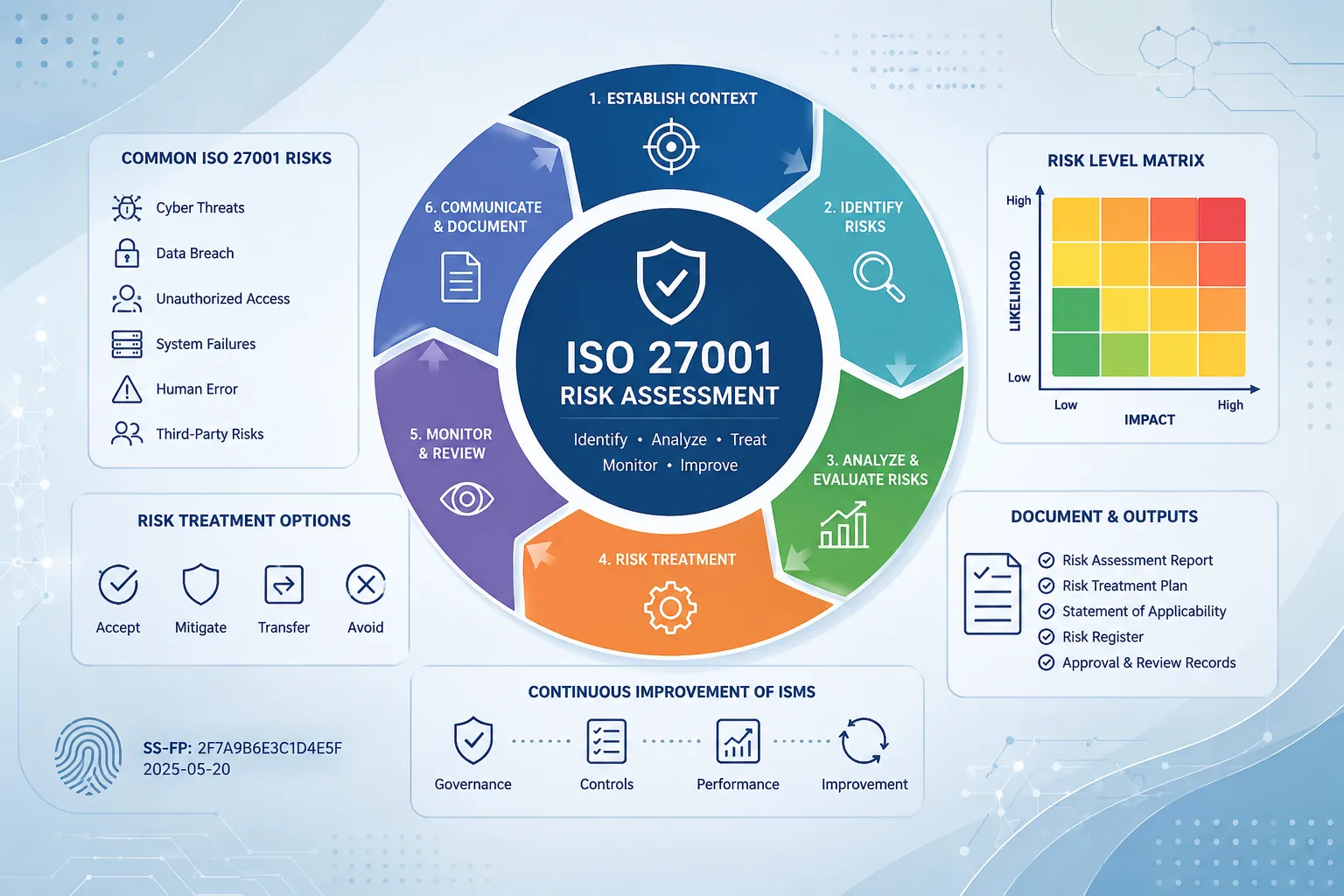
A typical risk identification and analysis process includes:
- Defining and documenting the assessment methodology
- Identifying information security risks
- Analyzing risks based on likelihood and business impact
- Prioritizing risks according to severity
- Selecting appropriate treatment measures
- Implementing relevant controls
- Documenting findings and treatment activities
- Reviewing risks regularly as the ISMS evolves
Organizations should also reassess risks after major operational changes such as cloud migrations, vendor onboarding, infrastructure updates, mergers, acquisitions, or security incidents.
Risk assessments are generally more effective when integrated into ongoing operational reviews instead of treated as annual documentation exercises.
ISO 27001 Risk Analysis and Treatment
Risk analysis and treatment should remain active parts of ISMS governance activities. Once risks have been identified and evaluated, organizations can determine the most appropriate treatment approach based on operational requirements and business objectives.
Common treatment approaches include:
- Reducing risks through additional controls
- Avoiding activities that create unacceptable risks
- Transferring risks through vendors or insurance
- Accepting risks within approved tolerance levels
A strong risk treatment plan typically includes:
- Identified risks and associated impacts
- Applicable security controls
- Assigned risk owners
- Implementation timelines
- Monitoring and review activities
- Links to the Statement of Applicability (SoA)
Organizations seeking more structured implementation support often explore ISO 27005 Lead Risk Manager training to strengthen operational risk management practices.
Common ISO 27001 Risk Management Mistakes
Even organizations with established ISMS programs sometimes struggle with risk management consistency. Problems often develop gradually when assessments become disconnected from operational activities.
Some of the most common ISO 27001 risk management mistakes include:
- Improper or vague ISMS scope definition
- Superficial assessments without detailed analysis
- Treating assessments like checklists
- Ignoring operational and business context
- Weak or inconsistent risk ownership
- Maintaining outdated risk registers
- Implementing poorly monitored controls
- Underestimating employee awareness and training needs
Organizations that regularly review risks, update treatment activities, and maintain operational accountability usually maintain stronger long-term ISMS performance.
Frequently Asked Questions
What Tools and Templates Can Be Used for ISO 27001 Risk Assessment?
How to Write an ISO 27001 Risk Assessment Report
Is There a Way to Simplify Document Management for ISO 27001?
How to Draft an ISO 27001 Risk Assessment Policy
What Are the Five Risk Assessment Methods?
Start Your ISO 27001 Risk Assessment
A structured ISO 27001 risk assessment process helps organizations improve information security governance, strengthen operational resilience, and maintain more effective ISMS management over time.
Organizations that continuously review risks, maintain clear treatment plans, and integrate risk management into operational decision-making are generally better prepared for audits, compliance reviews, and evolving information security challenges.
At SecuraStar, organizations can access implementation-focused guidance, operational support, and practical risk management assistance designed to simplify the ISO 27001 risk assessment process and strengthen long-term ISMS governance activities.
Get ISO 27001 Risk Assessment Support →
External References:
ISO/IEC 27001 Official Overview
PECB ISO/IEC 27001 Training Information