What Does a GRC Consultant Do?
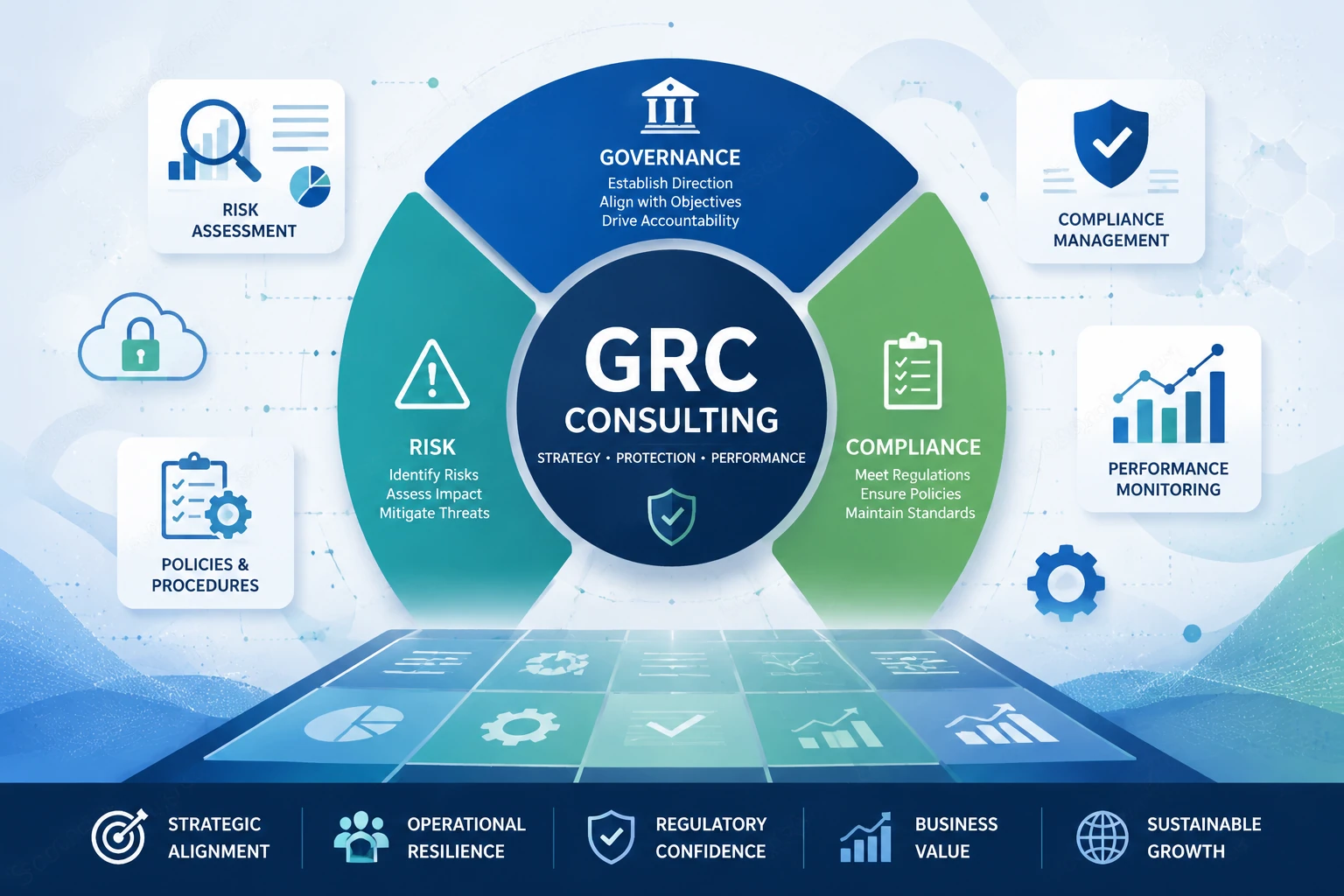
A Governance, Risk, and Compliance (GRC) consultant helps an organization turn regulatory obligations, business risks, and governance expectations into a practical operating program.
GRC consultants connect executive expectations with day-to-day implementation. They assess risks and compliance gaps, design policies and controls, prepare organizations for audits, support GRC technology, and establish clear ownership and reporting. Organizations often engage a GRC consultant when internal expertise is limited, requirements overlap, an audit is approaching, or the GRC program needs to scale.
Governance, risk, and compliance obligations can become fragmented as an organization grows. Security teams manage technical controls, legal teams interpret obligations, business owners operate processes, and auditors request evidence. Without a coordinated structure, responsibilities may be unclear and the same work may be repeated for different customers, standards, or regulators.
A GRC consultant brings these activities into a coherent framework. The consultant does not guarantee compliance or replace management accountability. Instead, the consultant gives leaders a defensible way to understand requirements, prioritize risk, assign ownership, and demonstrate how controls operate.
Explore ISO 27001 consulting and GRC implementation support →
What Is GRC?
GRC stands for governance, risk, and compliance. It is a coordinated approach for directing an organization, managing uncertainty, and meeting applicable obligations. GRC is broader than cybersecurity, although information security is often a major part of the program.
The three components have distinct but connected purposes:
- Governance defines decision rights, accountability, policies, objectives, oversight, and reporting. It establishes who is responsible for making and reviewing risk-related decisions.
- Risk management identifies uncertainty that could affect business objectives, evaluates likelihood and impact, selects treatment options, and monitors residual risk.
- Compliance translates applicable legal, regulatory, contractual, and standards-based requirements into controls, evidence, monitoring, and corrective action.
A mature GRC program connects these elements instead of treating them as separate checklists. For example, a customer security requirement may create a compliance obligation, lead to a risk assessment, require a control change, and need executive approval and ongoing reporting.
What Does a GRC Consultant Do?
A GRC consultant evaluates how an organization currently governs risk and compliance, defines an appropriate target state, and supports the work needed to close the gap. The exact scope depends on the organization’s industry, size, risk profile, contractual commitments, and chosen frameworks.
Assess the Current GRC Environment
The engagement commonly begins with document review, interviews, process walkthroughs, system scoping, and sampling of available evidence. The consultant compares actual practices with stated policies and applicable requirements. This helps distinguish a documentation gap from a control that is missing or ineffective.
Typical assessment outputs include:
- A defined scope, business context, and inventory of applicable requirements
- A risk register or updated risk assessment
- A gap analysis organized by requirement, control, owner, and evidence status
- A prioritized remediation roadmap based on risk and business dependency
Translate Requirements Into Controls
Regulations, contracts, and frameworks describe expectations in different ways. A consultant maps those expectations to a common control set so the organization can understand where one control supports several obligations. This reduces duplicated work and makes ownership easier to manage.
Control design must reflect the real operating environment. A policy that requires quarterly access reviews is useful only when the organization has defined the systems in scope, the reviewers, the review criteria, the evidence to retain, and the process for correcting exceptions.
Develop Policies, Procedures, and Governance
GRC consultants help create or improve policies, standards, procedures, risk criteria, committee charters, approval workflows, exception processes, and reporting structures. In an information security management system (ISMS), this work may include document control, management review inputs, risk treatment processes, internal audit planning, and corrective action tracking.
Good governance documentation reflects what the organization can consistently perform. The consultant should work with control owners to avoid producing a polished policy library that does not match day-to-day practice.
Prepare the Organization for Audits and Assessments
Audit readiness involves more than collecting documents shortly before fieldwork. A consultant can build an evidence plan, test control operation, conduct readiness reviews or mock interviews, identify missing records, and coordinate remediation before an independent audit or customer assessment.
The consultant may support the organization during an audit by organizing evidence and clarifying how controls operate. Independence boundaries still matter: the organization owns its controls, and the independent auditor or certification body makes the audit or certification decision.
Support GRC Technology Selection and Implementation
GRC platforms can help manage requirements, controls, risks, findings, evidence, policies, vendors, and reporting. A consultant may define requirements, evaluate platforms, configure workflows, migrate records, and design dashboards.
Technology should support an agreed process rather than substitute for one. Before implementation, the organization needs a clear control taxonomy, ownership model, review cadence, escalation path, and definition of authoritative data sources.
Build a Sustainable Operating Model
The long-term value of consulting comes from leaving the organization with a program it can operate. That may include training control owners, establishing key risk and performance indicators, defining committee reporting, scheduling recurring reviews, and transferring administration to an internal team.
A useful engagement therefore ends with named owners, realistic deadlines, defined evidence, measurable outcomes, and a cadence for reassessment—not only a list of findings.
Common GRC Consultant Deliverables
Deliverables should be tailored to the engagement, but most GRC consulting projects produce a combination of decision support, operational documentation, and implementation records. Common examples include:
- GRC strategy, program charter, and implementation roadmap
- Enterprise or information security risk assessment and risk treatment plan
- Compliance obligations register and requirements-to-controls mapping
- Policies, standards, procedures, and control descriptions
- Roles-and-responsibilities matrix and governance committee structure
- Audit readiness assessment, evidence index, and remediation tracker
- Third-party risk management workflow and supplier assessment criteria
- GRC platform requirements, configuration design, and reporting dashboards
- Training materials and a transition plan for internal owners
The quality of a deliverable is determined by whether teams can use it. Each recommendation should connect to a business objective, requirement, risk, accountable owner, target date, and expected evidence.
When Should a Business Hire a GRC Consultant?
A consultant is most useful when the organization needs specialized expertise, an independent view, or temporary capacity to move a defined program forward. The need is not limited to large or highly regulated enterprises.
Consider engaging a GRC consulting company when:
- Your organization is entering a regulated market or signing contracts with new security obligations.
- You handle sensitive, personal, financial, health, customer, or proprietary information.
- An audit, certification assessment, customer review, or due-diligence event is approaching.
- Compliance activities are spread across teams without central ownership or consistent reporting.
- Policies exist, but control performance and evidence collection are inconsistent.
- Several frameworks or customer questionnaires create duplicative work.
- You need to implement or restructure an ISMS or enterprise GRC program.
- Your organization is selecting a GRC platform or redesigning GRC workflows.
Before selecting a consultant, define the decision or outcome the engagement must support. A focused scope—such as an ISO 27001 gap assessment, risk assessment, or audit-readiness program—usually produces clearer responsibilities and more usable results than an open-ended request to “handle compliance.”
How to Evaluate a GRC Consultant
The right consultant should combine framework knowledge with the ability to understand business operations. Credentials can support credibility, but they do not replace relevant experience, sound judgment, and the ability to transfer knowledge.
During evaluation, ask prospective consultants to explain:
- Which industries, frameworks, regulations, and organization sizes they have supported
- How they determine scope and identify applicable requirements
- How findings will be prioritized according to risk and business impact
- What deliverables, milestones, dependencies, and client responsibilities are included
- How they validate that written controls match operational practice
- How knowledge and program ownership will transfer to internal teams
- Whether any independence or conflict-of-interest boundaries affect the engagement
Relevant professional credentials may include certifications in information security, risk, audit, privacy, or specific standards. The appropriate credential depends on the role and engagement; ISO/IEC 27001 is a management system standard, not a universal personal certification required for every GRC professional.
How GRC Consulting Supports ISO/IEC 27001
ISO/IEC 27001 consulting is one application of GRC consulting. An implementation consultant can help define the ISMS scope, identify interested-party and compliance requirements, conduct an information security risk assessment, develop the risk treatment plan, establish policies and controls, prepare internal audit activities, and organize management review inputs.
ISO/IEC 27001 implementation should be integrated with broader governance and enterprise risk processes where practical. Organizations can use a common risk method and control structure while preserving the specific evidence and governance needed for the ISMS. SecuraStar provides ISO 27001 risk assessment support and related implementation services; certification decisions remain with independent certification bodies.
For additional context, review SecuraStar’s ISO 27001 framework guide. Broader risk and governance references include ISO 31000:2018 risk management guidance and the NIST Cybersecurity Framework 2.0.
Build a Practical GRC Program With SecuraStar
SecuraStar LLC supports organizations with ISO consulting, implementation, risk assessment, gap assessment, and audit-readiness services. The work is designed to help internal teams define priorities, establish usable controls, organize evidence, and build a management system they can maintain.
You can also call +1 (855) 476-2701 or email info@securastar.com
Frequently Asked Questions
What skills are needed for a GRC role?
GRC professionals need critical thinking, risk analysis, research, clear writing, stakeholder communication, and project management skills. They must be able to interpret requirements, understand how business processes and technical controls operate, evaluate evidence, document gaps, and explain risk in terms that decision-makers can use.
Is GRC in high demand?
Organizations continue to need professionals who can coordinate cybersecurity governance, risk management, audits, customer requirements, and regulatory obligations. Demand varies by industry, geography, and experience level, but GRC skills are relevant across consulting, internal compliance, security, audit, privacy, and enterprise risk roles.
What is the difference between a GRC consultant and a GRC analyst?
A GRC consultant is usually engaged to assess a program, provide specialized advice, design improvements, or support a defined implementation. A GRC analyst is commonly an internal or embedded role responsible for recurring activities such as maintaining risk and control records, collecting evidence, monitoring findings, supporting assessments, and producing reports. Responsibilities can overlap, and job titles vary by organization.
Does GRC apply to all industries?
GRC principles can benefit organizations in any industry, although the applicable obligations and level of formality differ. A GRC program should be proportionate to the organization’s objectives, size, risk profile, contractual commitments, and legal or regulatory environment.
What certifications do GRC analysts need?
There is no single certification required for every GRC analyst. Useful credentials may cover information security, risk management, audit, privacy, or a framework relevant to the employer. Examples include CISA, CRISC, CGEIT, CISSP, and ISO/IEC 27001 implementer or auditor credentials. Experience interpreting requirements, evaluating controls, and working with business owners remains equally important.
How much does a GRC consultant cost?
GRC consulting costs depend on the scope, organization size, number of locations or systems, applicable requirements, current program maturity, and level of implementation support required. A focused gap assessment generally costs less than a multi-framework implementation or ongoing advisory engagement. Request a written scope that identifies deliverables, assumptions, client responsibilities, milestones, and any work billed separately.
How long does a GRC implementation take?
A GRC implementation may take several weeks for a narrowly scoped assessment and roadmap, while a broader program can take several months or longer. Timing depends on scope, existing controls, resource availability, remediation complexity, technology changes, and audit or certification deadlines. A consultant should establish phases and decision points after assessing the current environment.
Which frameworks do GRC consultants work with?
GRC consultants may work with management system standards, cybersecurity frameworks, assurance criteria, privacy requirements, industry regulations, and contractual obligations. Examples include ISO/IEC 27001, the NIST Cybersecurity Framework, SOC 2 criteria, privacy frameworks, and sector-specific requirements. The appropriate framework combination depends on the organization’s risk profile, customers, locations, and compliance obligations.
Can a GRC consultant help with audit readiness?
Yes. A GRC consultant can confirm scope, map requirements to controls, review evidence, test whether controls operate as described, conduct readiness interviews, and track remediation before an independent audit. The consultant can organize and support the process, but the organization remains responsible for its controls and the independent auditor or certification body makes the final assessment decision.
What happens during a GRC consulting engagement?
A typical engagement begins with scoping, document review, stakeholder interviews, and an assessment of current risks and controls. The consultant then documents gaps, agrees on priorities, develops or improves governance materials, supports remediation, and establishes reporting and evidence processes. The engagement should conclude with named owners, a practical roadmap, and knowledge transfer to the internal team.